after the treaty of guadalupe hidalgo, the liberty party gave way to what larger anti slavery party?
Political Abolitionism
Courtesy Indiana Segmentation, Indiana State Library
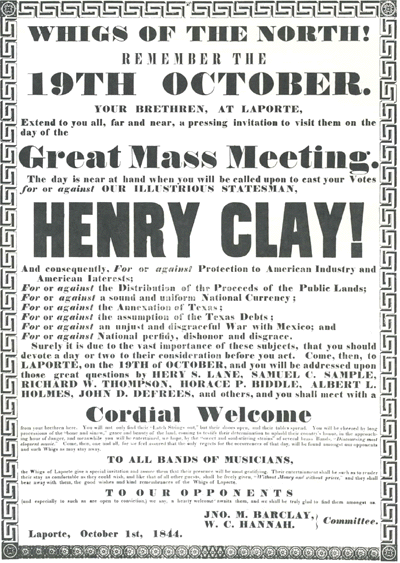
The Historic period of Jackson marked the expansion of political democracy and the growth of a nationally organized 2-party system. During these years several independent parties too emerged, some of them principally concerned with the growing sectional controversy. Abolition, and abolitionists, increasingly became involved in the political loonshit.
By the mid-1830s some members of the American Anti-Slavery Gild began to seek alternatives to moral suasion solitary--only met resistance in their own group. Garrisonians did not view political action as a means to accomplish their goals, yet both factions agreed that no truthful abolitionist could vote for whatsoever candidate who supported the slavery side of the argument. William Lloyd Garrison maintained that rather than vote for a neutral or pro slavery candidate, abolitionists should not vote at all. His opponents maintained that just by political action could they achieve their goals. This indicate became one impetus for a split among the members.
In 1838, abolitionist William Goodell published a serial of articles calling for political action against slavery. "The time has now fully come," Goodell asserted, "when the friends of liberty . . . should prepare themselves to put forth . . . political action confronting oppression." Goodell quoted The Emancipator to the effect that abolitionists could not, "with a good conscience, assist in placing men in office, who-they know will deed against the greatest involvement of the state." Moreover, according to Goodell, no laic in abolitionism could employ men who would utilise "their official power and influence in strengthening and defending [the] country'due south almost cancerous and dangerous enemy--slavery.''ane
In 1839 Garrisonians gained command of the executive offices of the American Anti-Slavery Society. During the same year Lewis Tappan, a wealthy New York abolitionist, formed the American and Foreign Anti-Slavery Lodge. This more politically oriented group asserted that political activity was needed to overcome constitutional and legal obstructions to emancipation. Myron Holley, an abolitionist from upstate New York, urged others to organize a political political party, and, in November, 1839, a convention met at Warsaw, New York, for this purpose.
Courtesy Indiana Historical Society Library
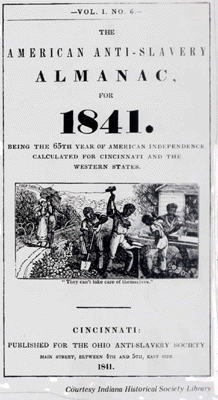
The Freedom party was organized for the sole purpose of defeating slavery in America. It sought the votes of northern conservatives by attempting to prove that the continued existence of slavery and the slaveholders' domination of the government threatened everyone's economical, political, and religious interests. Hence, the political party "provided a fashion of not voting for the parties which sinfully governed.''2 The party nominated James G. Birney, an ex-slave- holder and ex-member of the Alabama and Kentucky legislatures turned devout abolitionist, and Francis Julius LeMoyne for president and vice- president in 1840. Birney originally declined the nomination; he wanted to await and come across who the Democrats and Whigs would nominate. After the Democrats nominated Martin Van Buren and the Whigs selected William Henry Harrison, the Liberty party held a convention in Albany, New York, and renominated Birney for president with Thomas Earle as his running mate. And then repulsive were the Democratic and Whig nominations that Birney now accepted. The time had not yet come, all the same, for the ideas the Liberty party espoused; in the 1840 election it garnered simply 7,000 votes.
Engraving courtesy Adena Charlton
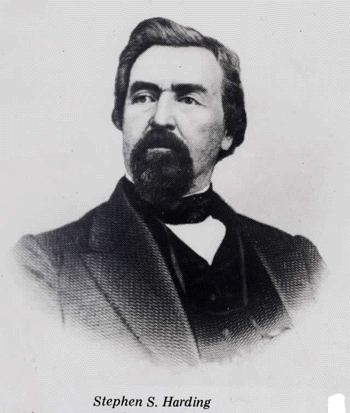
In September, 1842, the Liberty political party'southward state convention nominated Elizur Deming for governor and Stephen S. Harding for lieutenant governor. The party's election returns, however, comprised but approximately 1 per cent of the statewide vote. By 1852, the Liberty party had faltered in both the land and nation.three
In Indiana, the Henry County Female Anti-Slavery Order was past far the most overtly political female system in the state. These women, though they could non vote themselves, decided to be the power backside the ballot past influencing their husbands, fathers, and brothers. The Society stressed that Indiana's General Assembly had enacted diverse laws which had the tendency "to increase and strengthen . . . prejudice" and resolved to persuade their male person relatives to use their voting privileges to elect men "who will remove these evils by the introduction of righteous and just laws."4
In early on Nov, 1841, the Society appointed a commission to gear up a memorial to Congress asking that it use all its power to abolish slavery and to procure signatures of females friendly to the cause. The Guild forwarded the petition to John Quincy Adams, to whom the women believed the nation owed its gratitude "for his increasing efforts in favor of the Constitution and the right of petition." This committee also prepared a petition for the state legislature, request for repeal of the 1831 law requiring black emigrants to postal service bond and security for their skilful behavior and maintenance. Signatures were acquired, and the petition forwarded to Henry County Representative Robert K. Cooper. 5
In the early 1840s the proposed annexation of Texas (and then an contained commonwealth) became a major result in national politics. Abolitionists and antislavery advocates throughout the nation railed against annexation, fearing the extension of slavery into the Southwest. Once again the Henry County Female Anti-Slavery Society exercised its right of petition. "We believe," the women wrote, "the annexation of Texas into this Matrimony is calculated to strengthen and perpetuate the system of slavery and will tend to build up the aristocracy of the south and pause down the complimentary states of the North." Protesting the action of "Female person Whigs" who were not sufficiently antislavery, the Henry County women expressed their point of view poetically:6
Let adult female and so exert her powers
To bless this erring land of ours
To bring near that glorious day
When peace her sceptor bright shall sway,
O'er every mountain, hill or plain
Nor slave nor master shall remain
But all mankind shall brethren be
And each exult in liberty.
William G. Ewing of Fort Wayne besides expressed his concern over the disposition of Texas to Congressman, Andrew Kennedy in Washington, D.C. Texas, he asserted, with "a mild climate and fine soil can form a host of new states, if the south gets this," said Ewing, "as it is to exist feared information technology will with the curse of slavery, the southern and slave holding Interest volition preponderate in the councils of the Nation.''vii
Western political party men saw the demand to broaden their position. Salmon P. Chase, a Freedom party member from Ohio, led the call for a modification in the Birney faction's program. Hunt contended that firsthand abolition was non the only effect the party should stand for. Subsequently he and his followers founded the National Anti-Slavery Social club, which contended that the party could only constitutionally foyer for the abolition of slavery in the Commune of Columbia and the territories. In June, 1845, Chase and his followers held a convention in Cincinnati and formed a coalition. Virtually major political party journals, including the Indiana Free Labor Advocate, supported the coalitionists, who hoped to win the back up of antislavery members of the major parties.eight
Despite northern and abolitionist antipathy toward annexation, Texas was admitted to the Wedlock as a slave state in 1845. The Texas issue precipitated a crisis betwixt Mexico and the United States and resulted in the Mexican State of war of 1846-1848. Mexico's defeat, and the subsequent Treaty of Guadalupe Hidalgo, opened a huge expanse for potential American settlement. Fifty-fifty during the treaty negotiations the N-Due south battle over territorial expansion, and the status of slavery in such territory, continued. The subject became an issue in the presidential campaign of 1848, and Hoosiers paid close attention to the sides their candidates took.
By the tardily 1840s, with the standing strife over the extension of slavery, political parties further divided, and new ones formed. In the past, one source commented, political parties adult by "divisions of analogousness," only now divisions resulted along geographical lines. "There is," the colonizationist B. T. Kavanaugh wrote in 1847, "a new and fearful effort being fabricated to depart from the conservative and healthy grade of policy, and to produce divisions based upon Geographical lines!" This endeavor "to array one portion of the country against another, and to indulge a vituperative and vindictive spirit . . . threatens to arouse the aroused feelings on both sides of the line." He blamed both the abolitionists and pro slavery sympathizers for the impending crisis: "The foundation of this motility is, professedly, in a hatred to slavery among a portion of the citizens of the Due north, growing out of Abolitionism, and a restless pro-slavery spirit of a few of the citizens of the South." Kavanaugh insisted that colonization was the only culling to avoid disunion.ix
Courtesy Indiana Historical Society Library
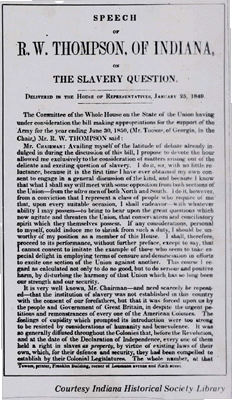
Stress over the impunity of the Mexican Cession likewise strained relations in the Autonomous party. David Wilmot, a Democrat from Pennsylvania, proposed a solution to the slavery extension outcome in 1846. The Wilmot Proviso, as information technology was called, argued that the newly acquired territory should be kept free of slavery. Some Hoosiers supported the Wilmot Proviso and formed the Indiana Wilmot Proviso League.x That system disbanded, withal, afterward Congress rejected the measure. The Wilmot Proviso later acted as an impetus for the germination of a new political party, the Free-Soil party. Schuyler Colfax, editor of the South Bend St. Joseph Valley Annals and a time to come congressman, was one Hoosier who supported the measure and encouraged others to do likewise.11
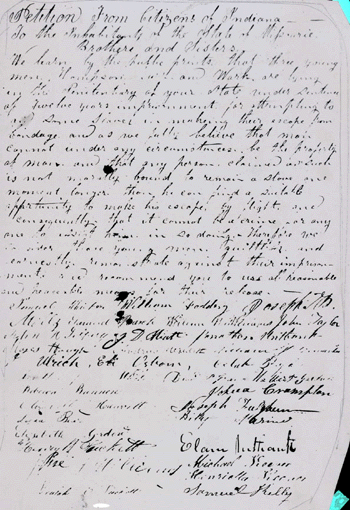
Petition from Citizens of Indiana to Inhabitants of the State of Missourie
Courtesy Indiana Historical Society Library
Transcription
Petition From Citizens of Indiana ----
To the Inhabitants of the Land of Missourie.
Brothers and Sisters,
We larn by the public prints that three young men Thompson, Burr and Wark are lying in the Penitentiary of your state under sentence of twelve years imprisonment for attempting to aid some slaves in making their escape from bondage and as we fully believe that man cannot under any circumstances exist the belongings of man and that whatever person claims as such is not morally bound to remain a slave one moment longer than he tin find a suitable opportunity to brand his escape past flight and consequently that it cannot exist a criminal offence for whatever ane to aid him in so doing – Therefore nosotros consider those immature men guiltless and earnestly remonstrate confronting their imprisonment and recommend you to use all reasonable and peaceable ways for their release –
[Names very difficult to transcribe]
Samuel _____, William Fadd___, Joseph ________, _______ _________, William Williams, John Taylor, John ______, J. D Piatt, Jonathan _________, Moses Haugh, ____ ______, Ulrich, Eli Osborn, ____ _____, ……………….
Rebecca Bannon, Elizabeth _______, Lyra Bear, Elizabeth Gordon, ______ __ckett, ____ _________, ______ ______, Jo___ Crampton, Joseph _______, _____ Marnie, Elam ___tianti, Michael Keever, Henrietta Keever, Samuel Kelly
The Gratuitous-Soil party, organized in 1848, manifested a quasi-antislavery platform. The party, even so, offered no sound threat to slaveholders' "property rights." Free-Soilers adopted Wilmot's proposal and thereby safely opposed slavery extension while they remained uncommitted to black equality. They opposed slavery extension into new territory, but supported the contention that slavery should remain in areas where information technology already existed. Whites, especially in the complimentary states and the new territories, feared economical competition from blacks; it was not unusual for both gratuitous and enslaved blacks in the Due south to hold skilled positions.
Though the Free-Soil party did not manifest true abolitionism, both abolitionist and antislavery supporters saw the advantage of banding together to support the party. As the move gained momentum in various Indiana counties, supporters felt more politically competent and confident. No longer satisfied with being on the defensive, they became more aggressive. "We are belongings mass meetings & getting ourselves a picayune warmer than we take always been before," Henry Charles asserted. "I am not now satisfied with acting only on the defensive, merely attack every old crouch. I must and I tin practise it with an energy & a boldness which I never and so fully realized earlier.''12 In 1852 the Gratis-Soil party nominated George Julian, a Wayne County antislavery advocate, for the vice-presidency of the United States.
Political abolitionists claimed that Congress had the authority to regulate federal territory. Schuyler Colfax, though not an abolitionist, favored the Wilmot Proviso and recommended that others do as well. Although, according to Colfax, Congress had complete authority to regulate policy in the territories, he believed "information technology would exist an imminent hazard to the Union" if the nation divided--North versus Southward--over the issue of the proviso.13
Congress, in an try to defuse the explosive issue, passed several laws known, collectively, as the Compromise of 1850. The provisions included: (1) admission of California equally a free state; (2) the organization of other territories without mention of slavery; (three) a new Fugitive Slave Law; and (four) prohibition of the slave trade in the Commune of Columbia. Abolitionists, in Indiana as elsewhere, were outraged by the Compromise of 1850--especially the revised Fugitive Slave Law--and believed that the Due north had "sold out" to the South. At the other end of the spectrum, pro slavery advocates were presently clamoring once over again for pop sovereignty and states' rights.
Slavery dominated the national policy of the next decade. As the dichotomy between the sides grew e'er more grievous, men like Andrew Jackson Harlan, an Indiana congressman from Grant County, could write a friend of like temperament in the nation'southward capital: "We have much feeling here on the discipline of Slavery & the Union & Disolution [sic] of the Union. How things will eventually terminate I know non--for the Marriage I hope.''14
4 years after the 1850 Compromise, national tensions over the slavery extension issue reached a new high. The Kansas-Nebraska Bill aggravated the struggle over states' rights versus the cardinal regime. The neb repealed the Missouri Compromise, which banned slavery north of the 36-30 line, and extended the principle of popular sovereignty to Kansas and Nebraska. Stephen Douglas, senator from Illinois, sponsored the bill and directed its passage through Congress. Though Kansas was not admitted to the Marriage until 1861, this issue precipitated southern aggression leading toward the Civil War.

Courtesy Indiana Historical Guild Library
The issue had divisive effects on Hoosier Democratic politics. For instance, Jesse Bright, one of Indiana'south senators, wrote Congressman William English language that he regretted that he and English language did not meet eye to eye on the bailiwick. "I am deplorable," Bright lamented, "I could not accept met you as promised in order to compare notes about Kansas. . . . Information technology is to be regretted that you & I could not have harmonized on this question. I hope, sincerely hope, we yet will be able to exercise so." l v
Jacob P. Dunn, a Lawrenceburg merchant, supported states' rights and pop sovereignty: "The people of the Territories must settle their domistic [sic] institutions without whatsoever outside influence in their own way with no trammels but such every bit the Constitution imposes. This old fashioned federalism that is not willing to trust the people wont do in our mean solar day.''sixteen
Horatio J. Harris, a former Indiana state legislator and state accountant who moved to Mississippi in 1847, expressed his concern to Governor Joseph Wright over the furnishings of abolitionists in Indiana regarding the Nebraska issue. But he voiced his conviction that, ultimately, the state's Autonomous political party would testify loyal to the states' rights side equally a thing of principle. "I trust," he wrote Wright, "the republic of Indiana will non exist led astray, past the side-bug which the Whigs and abolitionists are trying to force into your adjacent election, and that some other glorious triumph volition point their devotion to principle.''17
Wright supported the Nebraska faction of the controversy, believing that the Nebraska issue was ane of states' rights confronting centralization and that "the Whigs believe a few men at Washington City should human action & govern the people.''18 This position did not satisfy more politically acute observers. "No i," wrote John Hunt from Cambridge Urban center, "would ask y'all to sacrifice principle for role." He felt it was a thing of expediency, not principle. "The matter in controversy," he told Wright, "may be summed upward in a few words. The friends of the Nebraska Neb get for the extension of Slavery [and] confronting organized religion and temperance (not from Principle but from interest, politically). The Anti-Nebraska Political party go [sic] confronting slavery everywhere it can be done without interfering in States where it at present exists." "Information technology is fourth dimension," Hunt admonished Wright, "you lot 'showed your hand' to the globe . . . if you lot decide in favor of Nebraska y'all are politically damned. . . . The people of the Country will not sustain Slavery, Drunkenness, & adultery."19
Courtesy Indiana Segmentation, Indiana State Library
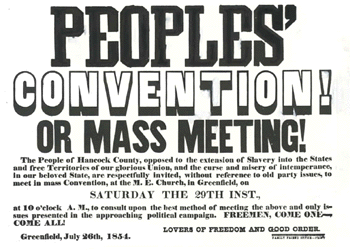
The Kansas-Nebraska controversy increased the ranks of those opposed to slavery extension; later the bill'southward passage, many Whigs and some Democrats joined the antislavery bandwagon. Schuyler Colfax, a shrewd political leader, decided to oppose the bill openly and called for " 'An Wedlock of Freemen For the Sake of Freedom.' "twenty Subsequently, Indiana opponents of the Nebraska bill denounced the repeal of the Missouri Compromise and formed the People'southward political party, which evolved into the state Republican political party. Composed of antislavery Whigs, anti-slavery Democrats, and Free-Soilers, the party chosen for repeal of the Avoiding Slave Law and the Kansas-Nebraska Human action and the restriction of slavery to the states where it already existed. Republicans nominated John C. Fremont as their presidential candidate in 1856, to oppose Democrat James Buchanan, who was elected.
During Buchanan'due south presidency, the Usa Supreme Court rendered a determination which further agitated the slavery controversy. Dred Scott, a slave of a Missouri slaveholder, claimed that he was costless because he once had resided in gratis territory. His court battle, which spanned xi years, went through several state courts and was finally decided past the Supreme Court in 1857. Principal Justice Roger B. Taney, a slaveholder from Maryland, read the judicial decision; past a vote of 7 to two the Court found that blacks were not citizens of the U.s.. Taney further pronounced that blacks had no rights that whites were spring to respect. The Court besides declared that the Missouri Compromise was unconstitutional and that Congress had no power to regulate slavery in the territories. 21
The Dred Scott decision was a defeat for abolitionists, who now placed their hopes on the Republican party even though it did not completely incorporate their goals. Past the tardily 1850s, nevertheless, the Republican party'southward advocacy of free soil principles further threatened the peace and security of the Spousal relationship. It was non the cure for the problems incurred since the Compromise of 1850. "I intend to be perfectly frank in what I say," Corydon resident Thomas C. Slaughter wrote Daniel Pratt; "I dislike very much 'an organization resting on a sectional basis.' . . . Here lies the danger in the republican motility of the N. Though I take been a determined opponent of slavery extension, and feel that every sentiment common to the people of the Northward has been outraged by the repeal of the Missouri prohibition, and more recently by the outrages in Kansas, yet I practise not recognize the necessity of abandoning all other questions and going to battle on a single idea, the 2 that brings the N and the South in direct and open up antagonism with each other, leaving no common ground for the two sections to stand on." He so predicted that if the North and the S had an open up disharmonize over the slavery question no 1 would emerge the victor. "Allow the North and South," Slaughter warned, "once face each other on this naked question, and I care not what men say, there is danger to the Union." He connected, "I do not inquire any human to stand on the slavery platform . . . but I practise insist that we should non abandon the American idea. . . . It is true I detest compromises . . . but I practice love this Union fifty-fifty more than I hate slavery.''22
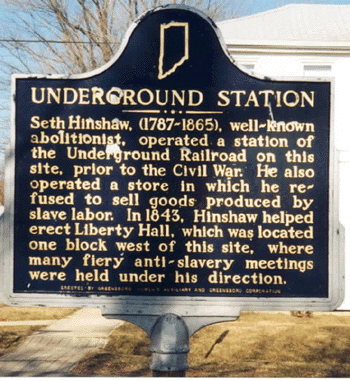
Historical marking in Henry County
SE corner Main Street & Greensboro Pike, Greensboro.
Lincoln, the Emancipation Proclamation, and Freedom
"Bury Me in a Free State" chapter list
- Footnotes to "Political Abolition"
Source: https://www.in.gov/history/for-educators/all-resources-for-educators/resources/underground-railroad/bury-me-in-a-free-land-the-abolitionist-movement-in-indiana-by-gwen-crenshaw/political-abolitionism/
0 Response to "after the treaty of guadalupe hidalgo, the liberty party gave way to what larger anti slavery party?"
Post a Comment