Vultures Gathering on the Side of the Road to Eat Are Called What
| Vulture Temporal range: [i] | |
|---|---|
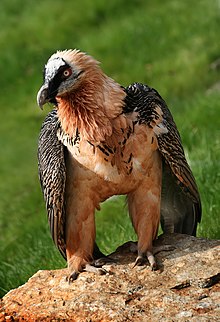 | |
| Lammergeier at Alpenzoo, Innsbruck, Austria | |
 | |
| Black vulture in Panama | |
| Scientific classification | |
| Kingdom: | Animalia |
| Phylum: | Chordata |
| Class: | Aves |
| Families | |
| |
A vulture is a bird of prey that scavenges on carrion. There are 23 extant species of vulture (including Condors).[two] Old World vultures include 16 living species native to Europe, Africa, and Asia; New World vultures are restricted to North and Due south America and consist of seven identified species, all belonging to the Cathartidae family[2] [3] A particular characteristic of many vultures is a bald, unfeathered caput. This bare pare is thought to keep the head clean when feeding, and also plays an important part in thermoregulation.[iv]
Vultures have been observed to hunch their bodies and constrict in their heads in the cold, and open their wings and stretch their necks in the oestrus. They also urinate on themselves as a ways of cooling their bodies.[5]
A group of vultures in flight is chosen a 'kettle', while the term 'committee' refers to a group of vultures resting on the basis or in trees. A group of vultures that are feeding is termed 'wake'.[6]
Taxonomy [edit]
Although New World vultures and Sometime World vultures share many resemblances, they are not very closely related. Rather, they share resemblance considering of convergent evolution.[7]
Early naturalists placed all vultures under one single biological group. Carl Linnaeus had assigned both Old Globe vultures and New World vultures in a Vultur genus, fifty-fifty including the Harpy eagle. Soon anatomists carve up Old and New Earth vultures, with New World vultures beingness placed in a new suborder, Cathartae, afterwards renamed Cathartidae as per the Rules of Nomenclature (from Greek: carthartes, significant "purifier")[8] by French ornithologist Frédéric de Lafresnaye.[ix] The suborder was after recognised as a family, rather than a suborder.
In the late 20th century some ornithologists argued that New Earth vultures are more closely related to storks on the basis of karyotype,[10] morphological,[11] and behavioral[12] data. Thus some authorities placed them in the Ciconiiformes family with storks and herons; Sibley and Monroe (1990) even considered them a subfamily of the storks. This was criticized,[13] [14] and an early Deoxyribonucleic acid sequence study[xv] was based on erroneous data and after retracted.[sixteen] [17] [18] There was then an attempt to raise the New Globe vultures to the rank of an independent order, Cathartiformes not closely associated with either the birds of prey or the storks and herons.[xix]
One-time World vultures [edit]

Some members of both the One-time and New World vultures accept an unfeathered cervix and caput, shown as radiating oestrus in this thermographic image

Griffon vultures scavenging a red deer carcass in Spain


Vulture preparing to land in Republic of kenya


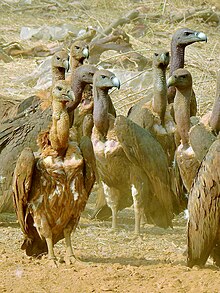
Flock of white-rumped vultures in India

The Sometime Globe vultures found in Africa, Asia, and Europe belong to the family Accipitridae, which likewise includes eagles, kites, buzzards, and hawks. Old World vultures detect carcasses exclusively by sight.
The 16 species in 9 genera are:
- Cinereous vulture, Aegypius monachus
- Griffon vulture, Gyps fulvus
- White-rumped vulture, Gyps bengalensis
- Rüppell's vulture, Gyps rueppelli
- Indian vulture, Gyps indicus
- Slender-billed vulture, Gyps tenuirostris
- Himalayan vulture, Gyps himalayensis
- White-backed vulture, Gyps africanus
- Cape vulture, Gyps coprotheres
- Hooded vulture, Necrosyrtes monachus
- Red-headed vulture, Sarcogyps calvus
- Lappet-faced vulture, Torgos tracheliotos
- White-headed vulture, Trigonoceps occipitalis
- Bearded vulture (Lammergeier), Gypaetus barbatus
- Egyptian vulture, Neophron percnopterus
- Palm-nut vulture, Gypohierax angolensis
New Earth vultures [edit]

American Black Vulture congregated at roadkill site
The New World vultures and condors found in warm and temperate areas of the Americas are non closely related to the similar Accipitridae, merely belong in the family Cathartidae, which was once considered to be related to the storks. Nonetheless, contempo DNA evidence suggests that they should be included among the Accipitriformes, forth with other birds of casualty. However, they are nevertheless non closely related to the other vultures. Several species accept a proficient sense of smell, unusual for raptors, and are able to aroma expressionless animals from great heights, up to a mile away.
The vii species are:
- Blackness vulture Coragyps atratus in Due south America and north to the The states
- Turkey vulture Cathartes aura throughout the Americas to southern Canada
- Lesser yellow-headed vulture Cathartes burrovianus in South America and north to Mexico
- Greater yellow-headed vulture Cathartes melambrotus in the Amazon Basin of tropical S America
- California condor Gymnogyps californianus in California, formerly widespread in the mountains of western North America
- Andean condor Vultur gryphus in the Andes
- King vulture Sarcoramphus papa from southern Mexico to northern Argentina
Feeding [edit]
Vultures are scavengers, meaning that they eat dead animals. Outside of the oceans, vultures are the only known obligate scavengers.[20] They rarely attack healthy animals, merely may kill the wounded or sick. When a carcass has too thick a hide for its beak to open, information technology waits for a larger scavenger to eat first.[21] Vast numbers accept been seen upon battlefields. They gorge themselves when prey is arable, until their crops bulge, and sit, sleepy or one-half torpid, to digest their food. These birds practice not comport food to their young in their talons but disgorge it from their crops. The mount-dwelling bearded vulture is the only vertebrate to specialize in eating bones,[22] and does carry bones to the nest for the young, and information technology hunts some live prey.
Vultures are of neat value as scavengers, especially in hot regions. Vulture tummy acid is exceptionally corrosive (pH=1.0[22]), assuasive them to safely digest putrid carcasses infected with botulinum toxin, hog cholera bacteria, and anthrax leaner that would be lethal to other scavengers[23] and remove these bacteria from the surround. New World vultures oft vomit when threatened or approached. Contrary to some accounts, they do not "projectile vomit" on their assaulter in defence, just to lighten their stomach load to ease take-off. The vomited meal residuum may distract a predator, allowing the bird to escape.[24]
New World vultures also urinate straight down their legs; the uric acid kills bacteria accumulated from walking through carcasses, and also acts as evaporative cooling.[25]
Conservation status [edit]
Vultures in southward Asia, mainly in India and Nepal, have declined dramatically since the early 1990s.[26] It has been found that this decline was caused by residues of the veterinary drug Diclofenac in brute carcasses.[27] The government of India has taken very belatedly cognizance of this fact and has banned the drug for animals.[28] However, information technology may take decades for vultures to come back to their earlier population level, if they always exercise: without vultures to choice corpses clean, rabies-carrying dogs have multiplied, feeding on the carrion, and historic period-old practices like the sky burials of the Parsees are coming to an end, permanently reducing the supply of corpses.[29] The same problem is as well seen in Nepal where government has taken some tardily steps to conserve remaining vultures. Similarly, in Central Africa there has also been efforts to conserve the remaining vultures and bring their population numbers dorsum up. This is largely due to the bushmeat merchandise, "information technology is estimated that more than one×10 ^ 9 kg [two.2×10 ^ 9 lb] of wild brute meat is traded" and vultures take upwards a large per centum of this bushmeat due to the need in the fetish market.[30] The substantial drop in vulture populations in the continent of Africa is also said to be the upshot of both intentional and unintentional poisoning, with one report finding it to be the cause of 61% of the vulture deaths recorded.[31]
The vulture population is threatened across Africa and Eurasia. There are many anthropogenic activities that threaten vultures such as poisoning and wind free energy collision mortality.[32]
A recent study in 2016, reported that "of the 22 vulture species, nine are critically endangered, three are endangered, four are almost threatened, and half-dozen are least concern".[33]
The conservation status of vultures is of particular concern to humans. For example, the decline of vulture populations tin can atomic number 82 to increased disease transmission and resources impairment, through increased populations of disease vector and pest animal populations that scavenge carcasses opportunistically. Vultures control these pests and disease vectors indirectly through contest for carcasses.[34]
On xx June 2019, the corpses of 468 white-backed vultures, 17 white-headed vultures, 28 hooded vultures, 14 lappet-faced vultures and x greatcoat vultures, altogether 537 vultures, besides 2 tawny eagles, were establish in northern Botswana. It is suspected that they died later eating the corpses of 3 elephants that were poisoned by poachers, possibly to avoid detection by the birds, which help rangers to runway poaching activity by circling above where there are dead animals.[35] [36] [37] [38]
In myth and culture [edit]
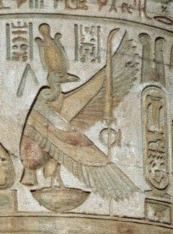
In Ancient Egyptian art, Nekhbet, a mythological goddess and patron of both the metropolis of Nekheb and Upper Egypt[39] was depicted as a vulture. Alan Gardiner identified the species that was used in divine iconography as a griffon vulture. Arielle P. Kozloff, still, argues that the vultures in New Kingdom fine art, with their blue-tipped beaks and loose skin, improve resemble the lappet-faced vulture. Many Great Royal Wives wore vulture crowns - a symbol of protection from the goddess Nekhbet.[40]
Ancient Egyptians believed that all vultures were female and were spontaneously born from eggs without the intervention of a male, and therefore linked the birds to purity and motherhood, but also the eternal cycle of death and rebirth for their ability to transform the "expiry" they feed on – i.e. feces and waste – into life.[41]

The Aztec vulture vessel at the new Pre-Columbian Mesoamerican Pottery Gallery
In Pre-Columbian times, vultures were appreciated as extraordinary beings and they had loftier iconographic condition. Vultures appear in many Mesoamerican myths, legends, and fables, with many split up civilizations such as the Mayan and Aztec developing a range of stories around vultures. Many Mesoamerican stories depict vultures negatively, while others comprise more positive attitudes.[42]
Meet also [edit]
- Jatayu
- Stele of the Vultures
References [edit]
- ^ "Fossilworks:Aegypiinae". Fossilworks. Retrieved 17 December 2021.
- ^ a b "Dropping expressionless: causes and consequences of vulture population declines worldwide" (PDF). 2001.
- ^ Amadon, D. (1977). "Notes on the taxonomy of vultures" (PDF). The Condor. 79 (4): 413–416. doi:10.2307/1367720. JSTOR 1367720.
- ^ Ward, J.; McCafferty, D.J.; Houston, D.C. & Ruxton, G.D. (2008). "Why exercise vultures have bald heads? The office of postural adjustment and blank skin areas in thermoregulation". Periodical of Thermal Biology. 33 (3): 168–173. doi:10.1016/j.jtherbio.2008.01.002.
- ^ Arad, Z. & Bernstein, M. H. (1988). "Temperature Regulation in Turkey Vultures". The Condor. 90 (4): 913–919. doi:x.2307/1368848. JSTOR 1368848.
- ^ Hamilton, S.Fifty. (2014). "Sky Burials". In Galván, J. (ed.). They Do What? A Cultural Encyclopedia of Boggling and Exotic Customs from around the Earth. Santa Barbara, California: ABC-CLIO. p. 289. ISBN978-1-61069-342-4.
- ^ Phillips (2000)
- ^ Brookes (2006)
- ^ Notes on the Taxonomy of Vultures The Condor Vol. 79, No. 4. 1977. pp. 413–416.
- ^ de Boer (1975)
- ^ Ligon (1967)
- ^ König (1982)
- ^ Griffiths (1994)
- ^ Fain & Houde (2004)
- ^ Avise (1994)
- ^ Brown (2009)
- ^ Cracraft et al. (2004)
- ^ Gibb et al. (2007)
- ^ Ericson et al. (2006)
- ^ Ruxton, 1000.D. & D.C. Houston. 2004. Obligate vertebrate scavengers must be large soaring fliers. J. Theor. Biol. 228: 431–436.
- ^ "Fast Vulture Facts". WebVulture.com. Archived from the original on July 18, 2011. Retrieved Feb 15, 2013.
- ^ a b Buechley, Due east. R. & Sekercioglu, C. H. (2016). "Vultures". Current Biology. 26 (13): R560–R561. doi:10.1016/j.cub.2016.01.052. PMID 27404248.
- ^ Caryl, Jim (September vii, 2000). "Re: How come that vultures can resist dangerous toxins when feeding on carcass". MadSci Network. Retrieved February fifteen, 2013.
- ^ "Turkey Vulture Facts". Turkey Vulture Society. Retrieved 2012-12-01 .
- ^ Conger, Cristen (2008-10-13). "Why is it a bad idea to scare a vulture?". HowStuffWorks. Retrieved February xv, 2013.
- ^ Prakash, Five.; Hurting, D.J.; Cunningham, A.A.; Donald, P.F.; Prakash, N.; Verma, A.; Gargi, R.; Sivakumar, S. & Rahmani, A.R. =u74p \ear=2003 (2003). "Catastrophic collapse of Indian white-backedGyps bengalensis and long-billed Gyps indicus vulture populations" (PDF). Biological Conservation. 109 (3): 381–390. doi:10.1016/S0006-3207(02)00164-7.
- ^ Oaks, J. 50.; Gilbert, Martin; Virani, 1000. Z.; Watson, R. T.; Meteyer, C. U.; Rideout, B. A.; Shivaprasad, H. 50.; Ahmed, S.; Chaudhry, Chiliad. J. I.; Arshad, M.; Mahmood, S.; Ali, A. & Khan, A. A. (2004). "Diclofenac residues as the cause of vulture population decline in Pakistan". Nature. 427 (6975): 630–633. Bibcode:2004Natur.427..630O. doi:10.1038/nature02317. PMID 14745453. S2CID 16146840.
- ^ Prakash, V.; Bishwakarma, M. C.; Chaudhary, A.; Cuthbert, R.; Dave, R.; Kulkarni, M.; Kumar, S.; Paudel, K.; Ranade, S.; Shringarpure, R. & Green, R. E. (2012). "The Population Decline of Gyps Vultures in India and Nepal Has Slowed since Veterinary Employ of Diclofenac was Banned". PLOS One. seven (xi): e49118. Bibcode:2012PLoSO...749118P. doi:10.1371/journal.pone.0049118. PMC3492300. PMID 23145090.
- ^ van Dooren, T. (2011). "Vultures and their People in Republic of india: Disinterestedness and Entanglement in a Fourth dimension of Extinctions". Australian Humanities Review (l). Archived from the original on 2016-10-11. Retrieved 2016-09-24 .
- ^ Buij, R.; Nikolaus, G.; Ogada, D.; Whytock, R. & Ingram, D.J. (2015). "Merchandise of threatened vultures and other raptors for fetish and bushmeat in Due west and Central Africa". Oryx. l (4): 606–616. doi:10.1017/S0030605315000514.
- ^ Ogada, D.; Shaw, P.; Beyers, R. L.; Buij, R.; Murn, C.; Thiollay, J. M.; Beale, C. M.; Holdo, R. 1000. & Pomeroy, D. (2016). "Another Continental Vulture Crisis: Africa's Vultures Collapsing toward Extinction". Conservation Letters. ix (2): 89–97. doi:10.1111/conl.12182.
- ^ Santangeli, A.; Girardello, M.; Buechley, E.; Botha, A.; Minin, Due east. D. & Moilanen, A. (2019). "Priority areas for conservation of Old World vultures". Conservation Biology. 33 (5): 1056–1065. doi:10.1111/cobi.13282. PMC6849836. PMID 30645009.
- ^ Buechley, E. R. & Şekercioğlu, Ç. H. (2016). "The avian scavenger crisis: Looming extinctions, trophic cascades, and loss of critical ecosystem functions". Biological Conservation. 198: 220–228. doi:10.1016/j.biocon.2016.04.001.
- ^ O'Bryan, C. J.; Holden, 1000. H. & Watson, J. E. M. (2019). "The mesoscavenger release hypothesis and implications for ecosystem and homo well-being". Ecology Messages. 22 (9): 1340–1348. doi:x.1111/ele.13288. PMID 31131976. S2CID 167209009.
- ^ "Over 500 Rare Vultures Die After Eating Poisoned Elephants In Botswana". Agence French republic-Press. NDTV. 2019-06-21. Retrieved 2019-06-28 .
- ^ Hurworth, Ella (2019). "More than than 500 endangered vultures die after eating poisoned elephant carcasses". CNN. Retrieved 2019-06-28 .
- ^ Solly, Thou. (2019). "Poachers' Toxicant Kills 530 Endangered Vultures in Botswana". Smithsonian. Retrieved 2019-06-28 .
- ^ Ngounou, B. (2019). "Botswana: Over 500 vultures establish dead subsequently massive poisoning". Afrik21. Retrieved 2019-06-28 .
- ^ Wilkinson, R.H. (2003). The Complete Gods and Goddesses of Ancient Egypt. Thames & Hudson. pp. 213–214.
- ^ "The Ancient Egyptian Goddess of Pregnancy".
- ^ "Life Egyptian Vulture". 2018.
- ^ Benson, Elizabeth P. The Vulture: The Heaven and the Globe.
- Hilty, S. L. (2003). Birds of Venezuela. London: Christopher Captain Publishers. ISBN978-0-7136-6418-8. OCLC 51031554.
External links [edit]
 | Wikiquote has quotations related to: Vulture |
 | Look upwardly vulture in Wiktionary, the costless dictionary. |
- Vulture videos on the Internet Bird Collection
- Ventana Wild animals Lodge Archived 2016-10-xix at the Wayback Machine
- Vulture observatory in Spain
- A Vulture Restaurant
- Failing Vulture Count in India
- Vulture Conservation in Western Coast of India
- Website for journal Vulture News
Source: https://en.wikipedia.org/wiki/Vulture
0 Response to "Vultures Gathering on the Side of the Road to Eat Are Called What"
Post a Comment